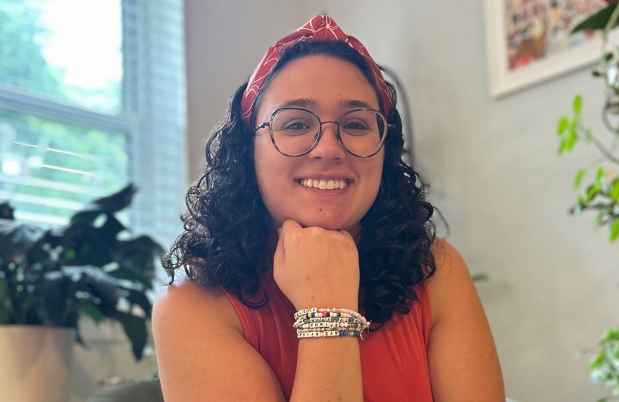
Mandy
Mandy
Finding joy
That’s how Mandy describes her search for solutions to the many obstacles that life has thrown her way. From her early struggles with obsessive compulsive disorder (OCD), anorexia, and self-medicating with alcohol to today, Mandy has been seeking the right approach to treatment—and she has also been finding authenticity, purpose, and a sense of joy in the world around her.
Her journey began when she was nine years old.
I remember being with my friends, and we were going to play softball. I started to have thoughts over and over, like ‘I’m not bad. I’m good,’ and ‘We’re going to win. We’re not going to lose.’
As time went on, Mandy began to have similar, repetitive thoughts: “I’m smart, I’m not dumb,” and “I’m thin, not fat, I’m thin.” She also began to display other signs of OCD, like being careful to step on the same crack again and again as she walked down the street or turning on faucets and lights in the same, precise way, over and over.
I was having all of these thoughts, and pressure was starting to build. I wondered if people around me handled these oddities too, and I just wasn’t good at it.

In high school, Mandy excelled in academics and in basketball, where she aimed to land a scholarship to a top college program.
I was a perfectionist, Type A on the outside, and I would hide my imperfections from everyone.
At 15, Mandy was diagnosed with and treated for OCD and anorexia. She struggled in her later high school years but overcame her eating disorder. Still, her plans for an athletic future were thrown off course after she suffered a fracture in her foot. Then, she headed off to college, where things got worse.
I started drinking heavily to relax my brain. I was impressionable. I fell into destructive patterns and relationships. I pulled away from my family. It was my darkest time.
After graduation, Mandy found that she wasn’t equipped to discontinue drinking on her own, so she sought out a program at an intensive outpatient rehabilitation center.
For me, it was a life-changing experience. I learned how to be real with myself and others, to feel emotions, and to speak my truth. I rediscovered my character and my values. I started to understand that resiliency is important and that authenticity allows me to find genuine satisfaction in life.
Mandy had things under control, but some of her old issues resurfaced when she moved from her native Wisconsin to the Boston area and took a high-pressure, fast-paced job in the technology industry. The work, coupled with a long, stressful daily commute, took a toll on Mandy.
To address her stress and anxiety, she went to an OCD therapist at McLean Hospital, where she started additional treatment for OCD. With the help of her loved ones and the team at McLean, she learned more and more about the condition—and herself.

Today, Mandy is sharing what she has learned with others. She has started giving talks about her OCD. She describes her journey and helps others find joy.
No one wants the world to know our deepest, darkest secrets. We feel guilty, ashamed, and embarrassed. But, for me, the best part about going through all of this is that I’ve learned I can always find something to be grateful for—little pockets of joy. And finding what makes you the best version of yourself is what you should pursue.
Building on her own experience, Mandy also wants others who face challenges with mental health to keep fighting and stay focused on growing and being healthy in mind, body, and spirit.
I don’t want anybody to give up. There’s always a solution. Even if you can’t see it right now, you will.