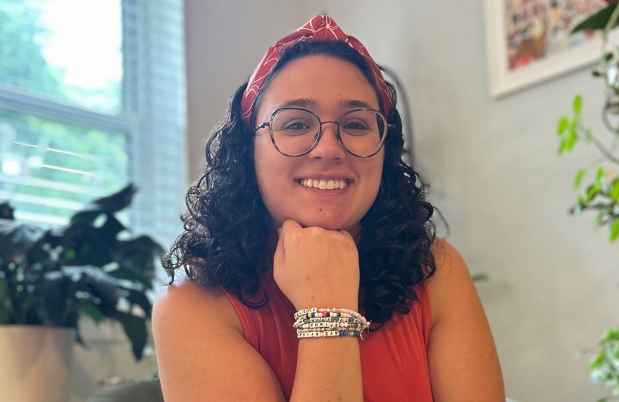
Maria
Maria
When you listen to others, you realize you are not alone
I surrender my soul to Jesus Christ eternally, infinitely, Lord Jesus.
Maria calls this phrase her “jingle.” She would repeat it occasionally in different contexts whenever a distressing thought entered her mind, such as when she feared that her salvation was at risk.
When reciting the jingle and making the sign of the cross, Maria felt relief for a moment, but it did not last. She repeated the words over and over again, sometimes multiple times a day. However, it was at home and at her aunt’s house where she expressed it more openly and frequently.
Her family knew the jingle well. They were also accustomed to Maria seeking reassurance about the salvation of her soul.
At times, they perceived her as manic. At other times, they would tell her she was weak and needed to have more faith.
What her family—and Maria herself—did not understand at the time was that she was experiencing scrupulosity, a form of obsessive compulsive disorder (OCD) involving obsessions and compulsions related to religious and moral concerns.
Maria recalls having intrusive thoughts and urges since childhood; however, her symptoms did not significantly interfere with her life until she transitioned from high school to college. The severity coincided with her mother’s cancer diagnosis at that time.
Maria spent five years unaware that she had a treatable mental health condition. She remembers that period as one marked by confusion, emotional distress, and shame.
When I had depression related to my OCD, my family told me to get out of bed and to snap out of it.
She also recalls an occasion when her father’s coworker saw her engaging in compulsions while she was driving to the university.
He called my father to say he was concerned about me because I was talking to myself. I felt sad for my father and ashamed. His coworker was also part of our religious community, which made it even more difficult.
“What I heard from my family happens often: In Puerto Rico, and in the Hispanic community more broadly, there is a lot of stigma surrounding mental health.”
Maria needed to be understood, but stigma made it challenging.
What I heard from my family happens often: In Puerto Rico, and in the Hispanic community more broadly, there is a lot of stigma surrounding mental health.
Practical barriers also played a role: The only specialist psychiatrist she found was located in Guaynabo, a city far from the small rural town where she lived. Although travel was difficult, she eventually managed to access care.
At first, the specialist thought I had schizophrenia because I lacked insight into what I was experiencing, but he eventually diagnosed me with OCD.
Receiving the correct diagnosis was transformative. For the first time, Maria’s experiences made sense. She received treatment with exposure and response prevention (ERP) therapy, which helped her disengage from her persistent doubts and need for reassurance.
Equally important was her participation in peer support groups for individuals with OCD.
They were incredibly beneficial. When you listen to others, you realize you are not alone and that you are not crazy.
Once she explained her condition to her family, they began to understand what was happening. They no longer attributed her behavior to a lack of faith or laziness. This support strengthened her motivation to help both individuals with OCD and their families better understand the condition.
Now with the support of her family, Maria transformed her challenges into purpose by becoming a licensed professional counselor with multiple certifications, including training in providing ERP therapy.
Today, she organizes support groups for individuals with OCD in Puerto Rico and provides workshops for families, individuals with the diagnosis, and professionals.
Maria is celebrating her 20 years of living with an OCD diagnosis by raising awareness about OCD through advocacy and public policy efforts. She has written several articles in local publications, recently published a children’s book inspired by her experience, and is promoting the designation of October 14 as OCD Awareness Day in Puerto Rico.
She is currently in the process of her doctoral studies in psychology. In her clinical practice, she plans to integrate her lived experience to help others facing similar challenges.
I want people to hear my story and be hopeful about their own future.
Maria’s story is also available in Spanish