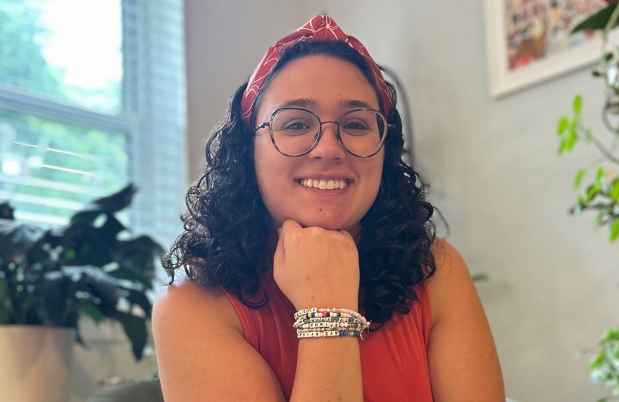
Brave Every Day: Rebecca Is Living Openly With OCD
Available with English captions and subtitles in Spanish.
As a child, Rebecca recalls being anxious, always striving for excellence. Now, she realizes she had one of the subtypes of obsessive compulsive disorder (OCD) called perfectionism OCD. Over time, another subtype appeared—one that was much more terrifying. Flashes of dangerous images played on a loop in her mind.
Through therapy, she was able to understand that those with harm OCD have no desire to act on their dark thoughts and in fact, the evolution of the disorder reflects their deep desire to protect themselves and others.
Rebecca’s OCD Journey
“I’m remembering the spring of my senior year of college. I felt absolutely glued to my bed. I had some really strange, intrusive thoughts pop up,” says Rebecca.
First, her intrusive thought content was around harmful objects. She might replay images of a knife chopping up and down, somebody holding a knife and using it on their skin. In another example, her thoughts surrounded images of an intruder entering her home or an intruder harming a child.
“The harm OCD thoughts would not stop. I didn’t know they were harm OCD at the time. Harm OCD really lives on the inside of people and you’re not going to be able to see it on the outside,” she shares.
As a child, Rebecca struggled with perfectionism.
“The way my writing looked had to be extremely neat, and it had to have the right curves and the right dots to the i’s and crosses to the t’s. And I just remember one day where I was just so [upset]. I just felt this stress when I knew logically that cursive shouldn’t be a scary experience.”
Toward the end of college, Rebecca noticed, “Oh, my mood is really sinking, and I’m not quite sure why. And there was a lot of hopelessness. It felt like something out of a movie, something I’ve heard other people experience, but not me. Like, why me? What did I do wrong?”
This is what pushed Rebecca to start seeing a counselor.
“At the beginning of our harm OCD-focused treatment, I was terrified of seeing graphic content on my Instagram, on TV shows, in the news. It would trigger me. I would feel very unsafe just because I saw something, and I would be concerned that a violent image or a graphic seen in the news would become my next intrusive thought, and it would,” Rebecca says.
“So, I would cut out media that might trigger me for, I’d say, a period of a couple months directed by my therapist so I could work through a lot of the harm OCD and then we could reintroduce it slowly back in.”
Rebecca is a foodie. She loves to cook, host friends and family, and entertain.
“Food is at the center of my life. So, when my intrusive thoughts and some of the images tacked onto kitchen items, items of utility, it was like the lowest blow that could ever happen to me. My cookbook collection is still very present in my life—I never had to remove that type of content.”
“But at some point, my therapist and I were working towards feeling very comfortable in my kitchen. And I can say now I can cook whatever I want in the kitchen with the sharpest of implements, and I’m confident. But it took me a long time.”
The journey toward health can be hard work, as Rebecca notes, “There is treatment, and treatment does work. I did a lot of work digging to find the perfect therapist for me who has a ton of skill, the provider that’s not going to jump to conclusions about my thoughts or my behaviors and is there for me every step of the way.”
Rebecca’s story is one of hope.
“Life feels very bright right now, and it might not in a couple weeks or a couple months. I still go through ebbs and flows, the lowest of lows, and the scariest of thoughts. And I’ve gotten through the days where I can’t go to work. I’ve gotten through all of those days. I’m so proud of myself. I really am.”
Rebecca wants others to know they are not alone.
“I’m telling my story because if I can make somebody else’s journey and story easier for them by spreading awareness and talking about the taboo subtypes of OCD so people know it exists and they can be encouraged that nothing’s wrong with them, then I will do that.”
“If I can make one person feel a little bit less alone and make one person feel a little bit less scared, then I’ll do anything, because I wish I had that.”
Read more of Rebecca’s story