Natalie
Natalie
This happened to me, and it shapes me
Natalie has worked as a counselor at both a treatment program for depression and an adolescent OCD program.
However, Natalie did not enter the health care field untouched by the systems she now works within. Like many working in mental health, she carries her own experiences with depression, anxiety, ADHD, borderline personality disorder (BPD), trauma, and body image struggles.
For Natalie, it all started in 8th grade after she shared an incident of abuse with a friend, who reported it to their school.
Starting therapy was not initially my choice.
What followed was the beginning of a long and complex relationship with mental health care.
Moving between different cultures and countries, she experienced care in Japan, the United States, and Singapore, which allowed her to witness how differently each system responds to stigma, crisis, and vulnerability.
For Natalie, transitions were difficult. Multiple life transitions brought about inpatient stays at different medical centers. Moves between countries and treatment facilities reopened past wounds, each setting revealing societal and cultural differences.
It wasn’t until she was attending boarding school in Massachusetts and received appropriate care for her needs that something clicked.
For the first time, treatment felt relational and skill-based. Emotion regulation tools and intensive community support gave me new understanding of experiences I had never been able to name.
She was able to learn that community is not limited to blood-related family. Natalie not only gained coping skills, but curiosity and patience about systems, identity, and how healing can unfold across different contexts.
Natalie turns to the philosophy of kintsugi to describe her experience. It is the Japanese art of repairing broken pottery using a lacquer mix, highlighting rather than hiding fractures:
“The cracks remain. They cannot be undone. But they can be integrated into the greater whole.”
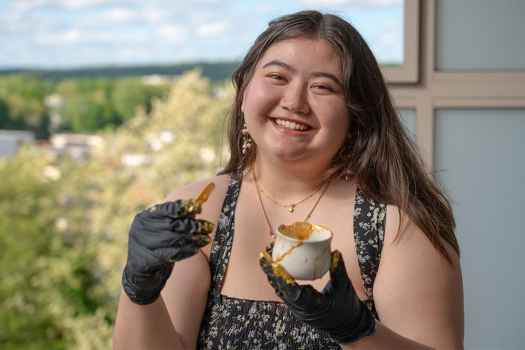
Natalie turns to the philosophy of kintsugi to describe her experience. It is the Japanese art of repairing broken pottery using a lacquer mix, highlighting rather than hiding fractures. To her, trauma fractured her sense of self, and she wanted to erase the cracks. She believed healing meant becoming unbroken, getting rid of the trauma, smoothing out the cracks.
The cracks remain. They cannot be undone. But they can be integrated into the greater whole.
She now maintains that what matters most is how one chooses to mend the cracks, not what caused them. She fills the cracks her trauma caused with curiosity, patience, skill-building, and community. She views each of those skills as the beautiful gold of a kintsugi piece. Through learning about cultures and systems, she now understands her journey differently.
I’m a person. Yes, this happened to me. And it shapes me.
Coming full circle, Natalie now works within a facility that once helped her rebuild, and she is now the one holding space for others navigating their own ruptures, regulation, repair, and return.
She has also co-founded a nonprofit dedicated to reducing mental health stigma while working as a research affiliate, exploring questions related to personality and psychedelic transformation.
She hopes that by sharing her story, both clinicians and patients will feel less alone.
The stigma is not just around patients. It lives in our professional training. In our silence. In the myth that helpers must be polished and untouched.
Clinicians are human. Patients are human. Systems are human-made and therefore imperfect.