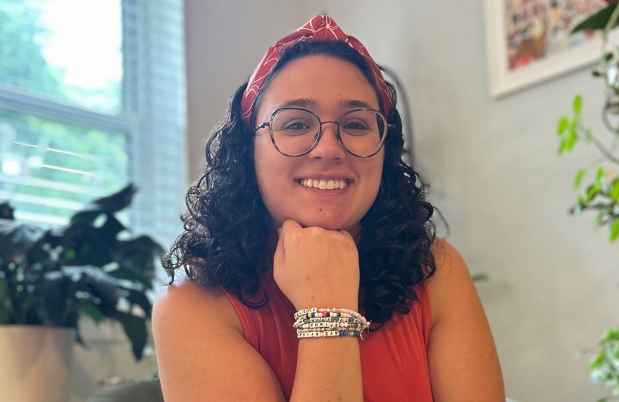
Amanda
Amanda
The strength I carry is much deeper than myself
I remember holding my baby and looking at pictures of him when he was an infant. I was sitting on my grandmother’s couch and in tears because I did not know how to handle my thoughts.
I loved my baby so much, but I couldn’t connect with him in the way I wanted to. I didn’t know what to do or how to be the person I wanted to be. I just cried.
I told my dad I needed to go get help and left my son with him. I went to the local ER, where I told the nurse admitting me that I am struggling with intrusive thoughts towards my son.
I was scared, and I couldn’t understand it.
Amanda started experiencing symptoms of anxiety and depression when she was about four or five years old. She felt shame and guilt at a very young age.

When she became pregnant at 19, she started having negative and disturbing thoughts, which she tried to push away.
During her pregnancy, she became depressed and anxious, and she went to the ER with a panic attack.
I was in a sad and vulnerable place. I was alone and scared and knew the dread would continue.
I was held at the hospital for hours against my will for my intrusive thoughts. Even the social worker said, ‘You’re being punished in a way for trying to get help. I feel so bad.’
Amanda’s issues intensified after her baby was born. She had trouble bonding with her child, and she was frightened by her recurring thoughts.
I kept going up to a different nurse during my short stay for reassurance because I wasn’t sure I had made the right choice.
I’ll never forget when she said, ‘The thoughts you are having are not normal.’ This local hospital was not familiar with OCD.
About a year later, Amanda went to Massachusetts General Hospital in Boston and was diagnosed with obsessive compulsive disorder (OCD).
Since then, she has been in treatment to learn how to cope when she notices her OCD symptoms intensifying.
She credits the support of her friends and family, as well as the OCD Institute at McLean Hospital, in helping her through her challenging times.
I’ve had friends and family over the years who I mentioned my worst fears and thoughts to. They believed in me and didn’t doubt the person I was, even though they did not understand what I was going through.
“What changed is when I stopped giving my thoughts power. That’s what gave me my freedom.”
These days, Amanda is managing her OCD and keeping herself extremely busy. She is married, and she homeschools her two sons. She is an avid reader and a writer who likes to work out and do crafts. She de-stresses by doing aerial silks, a creative performance activity.
What’s more, Amanda recently earned a nursing degree, and she hopes to secure full-time work in the field.
It is hard to describe the things I like, or I am potentially good at, because of my low self-esteem.
At the same time, my OCD has given me a chance to really indulge in the person that I am. It inspires most of the artistic abilities that I possess, such as writing or aerial.
Above all, it has brought me a lot closer to God. Any good that I possess is because of him. The strength I carry is much deeper than myself. Jesus rests on my heart, and it is in that moment that I can break the ‘fusion’ of my thoughts and ground my feet again, back on the earth.
Faith, family, and creativity have helped Amanda keep her in line with her recovery. These values helped her change her mindset about her condition and move ahead with her life.
My OCD made me believe I was this monster who did not deserve the most precious things in life—a family, a career, and the capability of loving myself.
What changed is when I stopped giving my thoughts power. That’s what gave me my freedom.