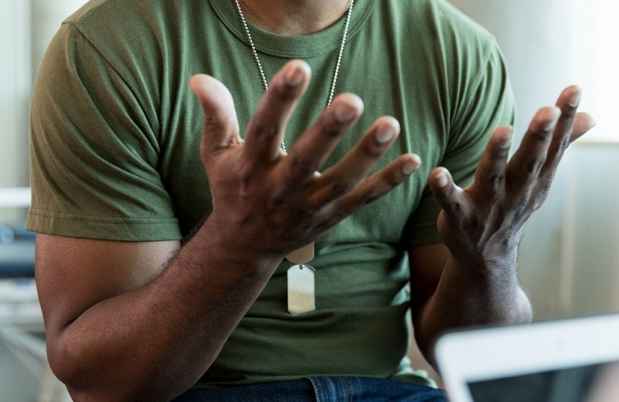
A Life of Service: Randall Shares His Journey Through Trauma and Healing
Available with English captions and subtitles in Spanish.
As a participant in Deconstructing Stigma, Randall—a veteran and commissioner of his state’s Department of Corrections—is sharing his mental health story of hope and healing. He wants others who are struggling to know they are not alone.
“In corrections and law enforcement, there are a lot of military veterans that bring that trauma with them. So, as warden, I try to ensure that my peers and subordinates keep an eye on each other and that we take care of each other emotionally as it relates to our profession.”
Randall’s Story
“I’ve been to hundreds of motor vehicle accidents, many, many suicides, many rescue scenes, a lot of death. An awful lot of death,” says Randall. “It’s dark, it brings you to a dark place. The reality is emotional scarring happens. It’s a natural response to have post-traumatic stress as a result of handling bodies and doing all the work that we do.”
Traditionally, for law enforcement, soldiers, firefighters, EMTs, etc., there has been a tradition of “Just suck it up and drive on.” We know now that we need to destigmatize and debunk this outlook.
Randall’s experience with trauma didn’t start on the battlefield or at work.
“The trauma that occurred in my childhood started at an early age. My father was domestically violent. He was an alcoholic. He was frequently incarcerated at the local county jails.”
His family’s situation resulted in poverty, food insecurity, and more, and this set the stage for trauma as a child, which didn’t change as he and his siblings grew up.
Randall’s interest in law enforcement and corrections began when he was a junior in high school. After graduation, he shipped out to Fort McClellan in Alabama, went to military police school, and received orders to go to Korea.
“That’s where I learned to be a police officer. And I enjoyed the aspect of being able to help people, help vulnerable people. So, when I came off active duty, I knew I wanted to go to college. And while I was doing that, I worked part-time as a police officer.”
“I’d go to a home where domestic violence was occurring, and I could really have empathy for the children and for the spouse that was being abused. I found enjoyment in resolving that issue.”
Randall applied for a deputy sheriff position and was hired. In 2004, he deployed to Iraq.
“During my tour in Iraq, we participated in seven major operations. It was very difficult. I looked in the eyes of my soldiers and said, ‘We might not make it out of here. You really have to fight like you’re already dead.’”
“In Iraq, I shot probably 3000 photos and short videos because I wanted to bring back to America the conversation—to let people know that before we quickly run off to war, we need to pause and think about the damage that it does,” Randall shares.
“And it’s not only the damage short term, but it’s the long-term damage to people’s moral injury, the post-traumatic stress that they come back with. And then when you come back, you’re still stuck in that combat mode that would serve you very well in combat. However, it doesn’t work well here.”
Though Randall was self-aware, it didn’t stop his traumatic experiences from affecting him.
“I was quick to anger. I was quick to emotion. I couldn’t talk for 30 seconds about Iraq before I would be emotional and break down.”
“It was at that point that my wife reached out to my brother, who’s a retired soldier, also. He came to visit me at work, and said, ‘Everything okay?’ And I opened up and it was an emotional conversation that we had. It was important for me to stand up and say, ‘I need help.’ And I went through counseling. Over time, I felt as though my symptoms were diminished.”
Randall’s own experiences help him as he works to help others.
“Any of the work that I’ve done in the last 20 years has been to really destigmatize mental health issues—tell people that they really need to consider getting help for themselves, for their families, for the children. I think that it has opened my eyes to a broader perspective and empathy. The project of Deconstructing Stigma is really important to me.”
In his role at work, Randall ensures there are plenty of mental health supports available for corrections staff and those who are incarcerated.
“We hold different seminars and relationships with organizations that allow us to do the preventive work before something happens and then to do ongoing work if there is a crisis. Having a greater understanding of humanity, destigmatizing mental health, and understanding we all need help: we get a much better outcome that way.”
“I believe that as a result of my traumatic experiences, that it’s opened my eyes to a broader perspective. And when I see visitors coming into the prison, I empathize with them. I say I was also the son of a resident. I’ve been there. And I think that brings a connection.”
“When I talk to fellow first responders, I can say I’ve been there. I’ve been to those fatal motor vehicle accidents. I’ve done more than 50 death notifications to families. I understand truly.”
“It certainly has broadened me, I think, as a person, as a leader, as a commissioner, as a warden, as a soldier. It’s made me a bigger, better person.”
Read more of Randall’s story